
17 Years Bringing You News from the Energy Capital of the Planet
 
Author: <span>Shiloh</span>

The TER 2nd Quarter 2023 Texas Energy Companies Earnings Roundup

Compare results from nearly 100 Texas companies

This Texas Energy Report database is published each quarter and is updated as earnings are released throughout the reporting period.
Click on the name of the company for more information about the quarterly earnings report, usually from the company’s own press release


AEP

American Electric Power (Nasdaq: AEP) reported second-quarter 2023 earnings, prepared in accordance with Generally Accepted Accounting Principles (GAAP), of $521 million or $1.01 per share, compared with GAAP earnings of $525 million or $1.02 per share in second-quarter 2022. Operating earnings for second-quarter 2023 were $582 million or $1.13 per share, compared with operating earnings of $618 million or $1.20 per share in second-quarter 2022.

Operating earnings is a non-GAAP measure representing GAAP earnings excluding special items. The difference between 2023 GAAP and operating earnings for the quarter was largely due to the mark-to-market impact of economic hedging activities and recent legislation in Texas regarding recovery of certain employee incentives. A full reconciliation of GAAP earnings to operating earnings for the quarter and year-to-date is included in the tables at the end of this news release.

__________________________


Amplify Energy

  • Achieved average total production of 21.2 Mboepd, up approximately 9% compared to the previous quarter
  • Generated net cash provided by operating activities of $4.9 million and net income of $9.8 million
  • Delivered Adjusted EBITDA of $17.6 million
  • Generated $6.1 million of free cash flow
  • Reaffirmed our full-year 2023 guidance
  • Entered into a new revolving credit facility with an initial borrowing base of $150 million and elected commitments of $135 million
  • As of July 31, 2023, net debt was $113 million, consisting of $120 million outstanding under the revolving credit facility and $7 million of cash on hand
  • Net Debt to Last Twelve Months (“LTM”) Adjusted EBITDA of 1.2x1
    (1)  Net debt as of July 31, 2023, and LTM Adjusted EBITDA as of the second quarter of 2023

__________________________


APA

Reported second-quarter 2023 adjusted earnings of 85 cents per share, beating the Zacks Consensus Estimate of 66 cents. The outperformance primarily reflects lower operating expenses and strong production.

However, the bottom line dropped from the year-ago adjusted figure of $2.37 due to significantly lower oil prices.

Revenues of $2 billion missed the Zacks Consensus Estimate of $1.8 billion and were down 35.7% from the year-ago quarter’s sales.

__________________________


Archrock Inc.

  • Revenue for the second quarter of 2023 was $247.5 million compared to $215.8 million in the second quarter of 2022.
  • Net income for the second quarter of 2023 was $24.7 million compared to $16.7 million in the second quarter of 2022.
  • Adjusted EBITDA (a non-GAAP measure defined below) for the second quarter of 2023 was $112.8 million compared to $99.5 million in the second quarter of 2022.
  • Declared a quarterly dividend of $0.155 per common share for the second quarter of 2023, an increase of 3.3% compared to the prior quarter, resulting in dividend coverage of 2.1x.
  • Repurchased 222,250 common shares at an average price of $9.33 per share for an aggregate of $2.1 million.
  • Achieved record period-end utilization of 95% for the second quarter of 2023 compared to 87% in the second quarter of 2022.
  • Raised 2023 Adjusted EBITDA guidance to a…
     

RRC Submits Comments on Proposed EPA Rules that Could Stifle Reliable Energy to Protect Texans

August 15 — The Railroad Commission of Texas (RRC) and the Texas Commission on Environmental Quality (TCEQ) submitted joint comments opposing the EPA’s proposed rule that would add regulations to fossil fuel-fired electric generating units in attempts to decrease carbon dioxide (CO2) emissions.

The likely outcome of this rule could result in the elimination of coal-fired units and a reduced ability to operate natural-gas fired power plants, which are critical for electricity supply in a state experiencing a booming population like Texas.

The comments also detail the unrealistic assumptions and artificially high metrics EPA used to estimate the climate benefits of the rule. Additionally, the supplemental costs involved, along with the additional infrastructure that would be necessary to implement the proposed requirements, would impose unreasonable costs in comparison to the anticipated benefits, all while placing reliable fuel supply for the electric…
 

RRC Accepting Applications for Texas Hydrogen Production Council Membership

August 14, 2023 — The Railroad Commission of Texas is accepting applications for membership on the Texas Hydrogen Production Policy Council (Council), which was created in House Bill 2847 passed by the 88th Legislature (Regular Session). The deadline to submit applications is Tuesday, September 5, 2023.

The Council’s duties include, but are not limited to:

  • studying the development of hydrogen industries in Texas;
  • monitoring regional efforts for the application and development of a regional clean hydrogen hub authorized under the federal Infrastructure Investment and Jobs Act;
  • developing a state plan for hydrogen production oversight by the RRC; and
  • making recommendations to the Legislature on legislative changes needed for the oversight and regulation of production, pipeline transportation, and storage of hydrogen.

The bill requires the RRC to appoint no more than 11 members to the Council, with at least three, but not more than five, representatives from the hydrogen industry. The chair of the Council will be the Chairman of the RRC or…
 

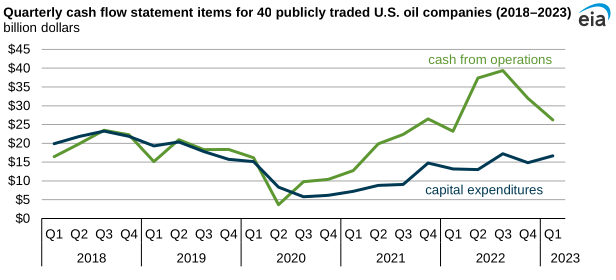
First-Quarter Capital Spending By Public U.S. Oil Companies Up, Cash from Operations Down: EIA

Quarterly cash flow statement items for 40 publicly traded U.S. oil companies

Data source: Evaluate Energy
Note: Q=Quarter

Financial results for 40 publicly traded U.S. oil exploration and production (E&P) companies show capital expenditure in the first quarter of 2023 increased from the fourth quarter of 2022, even though cash from operations declined. Previously, rising crude oil prices in the first half of 2022 had driven increased production and had helped companies post multiyear highs for cash from operations. Capital expenditure growth had been much slower over the past two years.

In the first quarter of 2023, lower crude oil prices reduced cash from operations for these companies, which declined 18% ($5.8 billion) compared with the fourth quarter of 2022, to $26.2 billion. At the same time, capital expenditure in the first quarter of 2023 was 12% ($1.8 billion) higher compared with the previous quarter, totaling $16.7 billion. As a result, capital expenditure as a share of cash from operations increased to 64%, the highest percentage since …
 

Texas Drilling Permit and Completion Statistics for July 2023: RRC

August 10, 2023 — The Railroad Commission of Texas issued a total of 772 original drilling permits in July 2023. The total includes 681 to drill new oil or gas wells, 6 to re-enter plugged wellbores and 73 for re-completions of existing wellbores.

The breakdown of well types for total original drilling permits in July 2023 is:  145 oil, 65 gas, 521 oil and gas, 35 injection, and six other permits.

In July 2023, Commission staff processed 740 oil, 208 gas and 499 injection completions for new drills, re-entries and re-completions.

Detailed data on drilling permits and well completions for the month can be found at this link:…
 

Oil, Gas Production Tries to Keep Up With Demand

By Alex Mills

The demand for crude oil and natural gas around the world has created upward pressure on price even though production is rising.

Crude oil in the U.S. is approaching record levels, outpacing Saudi Arabia and Russia, the other leading producing countries.

The U.S. Energy Information Administration (EIA) expects U.S. crude oil production to surpass 12.9 million barrels per day for the first time in late 2023 and to exceed 13 million barrels per day in early 2024, according to its monthly Short-Term Energy Outlook (STEO) released this week. EIA forecasts U.S. crude oil production to average 12.8 million barrels per day in 2023, which is 200,000 barrels per day more than in its July forecast.

EIA expects sustained global demand for petroleum products will continue to rise.

The Brent crude oil price (which is on the international exchange based in London) was near $75 per barrel at the beginning of July and increased throughout the month to surpass $86 per barrel on August 4, EIA stated. EIA forecasts the Brent crude oil price to increase the rest of 2023 and to approach $90 per barrel in late 2023….
 

8-18-23

Texas Energy Report NewsClips Friday August 18, 2023 Asterisk (*) denotes news stories that may be inaccessible because portions are behind a paywall   Top Stories   Politico-E&E News – August 17, 2023 …

The Mysterious Case of Disappearing Electricity Demand: IEA

August 5, 2023 — Electricity is at the heart of modern life, and so it’s easy to assume that our reliance on electricity will increase or even accelerate. However, in many advanced economies the data reveals a surprisingly different story.

Electricity demand has increased by around 70% since 2000, and in 2017, global electricity demand increased by a further 3%. This increase was more than any other major fuel, pushing total demand to 22 200 terawatt-hours (TWh). Electricity now accounts for 19% of total final consumption, compared to just over 15% in 2000.

Yet while global demand growth has been strong, there are major disparities across regions. In particular, in recent years electricity demand in advanced economies has begun to flatten or in some cases decline – in fact electricity demand fell in 18 out of 30 IEA member countries over the period 2010-2017. Several factors can account for this slowing of growth, but the key reason is energy efficiency.

There have been a range of new sources of electricity demand growth in advanced economies, including digitalization and the electrification of heat and mobility. However savings from energy efficiency have outpaced this growth. Energy efficiency measures adopted since 2000 saved almost 1 800 TWh in 2017, or around 20% of overall current electricity use….
 

Oil Prices Drop 20%, Expenditures Rise 26%

By Alex Mills

EDITOR’S NOTE: As publicly traded oil and gas companies begin reporting their second quarter financials, the Energy Information Administration released this week its financial analysis of first quarter 2023 of 40 exploration and production companies, which produced 31% (4 million barrels per day) of the oil in the U.S.  It does not include the smaller, privately held companies. Below is EIA’s analysis.

Crude oil prices have weakened since 2022 but remain relatively strong, which enhances cash flow as production in the U.S. sets records.

The West Texas Intermediate (WTI) crude oil price averaged $75.96 per barrel  in first quarter of 2023, a 20% ($19.21) decrease compared with first quarter 2022 and an 8% ($6.72) decrease compared with fourth quarter 2022.

Higher production resulted in cash from operations increasing 13% ($3.0 billion) compared with first quarter of 2022. Oil production nationwide has increased 1 million barrels per day in April (12.6 million barrels per day) compared to April 2022 (11.6 million barrels per day).

Capital expenditure in first quarter 2023 increased 26% ($3.5 billion) compared with first quarter 2022 to $16.7 billion and increased 12% ($1.8 billion) compared with fourth quarter 2022. Higher capital expenditure supported production increasing 9% (338,000 b/d) in first quarter 2023 from first quarter 2022 and 1% (59,000 b/d) from fourth quarter 2022…..
 

In “Watershed Moment” FERC Streamlines US Grid Interconnectivity

FERC Chairman Willie Phillips: “This is a watershed moment for our nation’s transmission grid. … This new rule will enable America’s vast power generation resources to connect to the grid in a reliable, efficient, transparent, and timely manner, and in doing so, help provide more reliable, resilient, and affordable electricity for all consumers.”

July 28, 2023 — The US Federal Energy Regulatory Commission (FERC) passed a new rule on Thursday that’s finally going to streamline the backed-up US grid interconnection process.

At the end of 2022, there were more than 2,000 gigawatts of bottlenecked new power generation and storage waiting to be connected across the US. That’s the same amount of electricity generation capacity as all the power plants currently operating around the country.

Projects have faced an average wait of up to five years to connect to the grid – and today’s ruling is expected to shorten that wait (we’ll keep an eye on it to see to what extent). More from electrek.

Click here to see the video of the…
 

Natural Gas Becomes Powerful Energy Source

By Alex Mills

Natural gas has blossomed into a dominate source of energy, supplying 41% of the energy to generate electricity across the U.S. and in many parts of the world.

Just 50 years ago, the federal government restricted the transportation and usage of natural gas through price controls. The policies resulted in shortages on the interstate markets even though there were plenty of supplies in states that produced natural gas.

The advocates for free markets won many political and legal battles through the years, and natural gas has become the fuel of the future.

Natural gas production in the U.S. has increased for 23 consecutive months as electric power distribution and liquefied natural gas (LNG) exports continued to rise.

U.S. dry natural gas production in February averaged 101.5 billion cubic feet per day (Bcf/d), which is 7 Bcf/d (7.4%) higher than the same period in 2022, “the highest level for any month since 1973 when we began tracking dry natural gas production,” according to the Energy Information Administration (EIA)

EIA also noted gross withdrawals of 123.1 Bcf/d, which is a 6.8% increase over last year of 115.3 Bcf/d, and it is the “highest daily rate of gross withdrawals for any month since 1980, the earliest year in this data set.”

Consumption of natural gas for electric power increased 7% over February 2022…..
 

Led by Houston Chronicle, Trend Emerges Among Texas News Websites Name-Checking Oilmen Wilks, Dunn and Families

July 18, 2023 — Since the waning days of the 2023 Texas Legislature‘s regular session, a new trend has emerged among certain state news websites in consistently linking through political contributions two state officials with three state oil billionaires and two political action groups.

There is a current controversy revolving around some donors contributing to both Lieutenant Governor Dan Patrick and Attorney General Ken Paxton, who will take adversarial roles in Paxton’s September impeachment trial in the Texas Senate, yet prominent identification of the Texas oil billionaires by the news websites well precedes this controversy.

In more than a dozen articles over the past two months the Houston Chronicle and Texas Monthly have joined Reform Austin and the Austin Chronicle — and on Tuesday, Texas Tribune, NBCDFW-TV and the Dallas Morning News— in naming Midland-based Crownquest Operating‘s Tim Dunn and Frac Tech founders Dan and Ferris Wilks as broad contributors to Lt. Gov. Patrick’s and AG Paxton’s fundraising campaigns, linking them all closely with the political groups Empower Texans and Defend Texas Liberty.

The news articles identify the political leanings of the Wilks and Dunn families as “conservative” or “Libertarian.”

In many cases, Mr. Dunn and the Wilks brothers were not the biggest contributors to the fundraising campaigns mentioned.

The billionaires, known for political activism, reportedly bet against Governor Greg Abbott in the 2022 election, into which they poured millions of dollars.

These are the many news articles dating from mid-May through this week linking the state officials with the oilmen (and family members) and the two political groups:

Texas Oil and Gas Production Statistics for April 2023: RRC

July 14, 2023 — Statewide and county crude oil and natural gas production for April 2023 reported in the tables below came from 162,884 oil wells and 87,005 gas wells.

Crude oil production reported by the RRC is limited to oil produced from oil leases and does not include condensate, which is reported separately by the RRC. For full oil and gas production statistics, you can visit the links below….
 

A Surprising Number of Water Laws — Survey of New Texas Environmental and Regulatory Laws Enacted in the 88th Session: Cavender & Trahan

Posted 

This is a brief survey of many of the environmental and regulatory laws passed by the Texas Legislature and signed by the Governor in the 88th Regular Session of the Legislature, which ended in May 2023, although a special session has been called to address lingering matters. Altogether, more than 1,000 laws were enacted in this session, including a surprising number of water-related environmental bills.


Water

HB1565 relates to the functions of the Texas Water Development Board and continuation and functions of the State Water Implementation Fund for Texas Advisory Committee. Effective 9.1.23.

HB1699 relates to the authority of the Evergreen Underground Water Conservation District to impose certain fees. Effective 6.9.23.

HB1845 amends Section 37 of the Water Code to add Section 37.0045 relating to the licensing requirements for certain operators of wastewater systems and public water systems. Effective 9.1.23.

HB1949 amends Section 12.057(b) of the Natural Resources Code to require a final report by the Red River Boundary Commission no later than July 30, 2027. Effective 5.24.23.

HB1971 amends sections of the Water Code relating to the procedures for acting on a permit or permit amendment application by a groundwater conservation district and the disqualification of board members of groundwater conservation districts. Effective 6.9.23….
 

Update Saturday: Explosion, Fire at Dow Plant in Louisiana

Update: As of 8:30 pm Saturday, Dow Louisiana Operations stated that the fire has been greatly reduced in size but is still burning and Dow crews are working to keep the fire contained.

No other details were released.

Original story:

July 15, 2023 — At least one explosion and a fire last night at a Dow plant in Plaquemine LA south of Baton Rouge (in Iberville Parish) have had firefighting crews working overnight.

The plant is among the largest petrochemical facilities in Louisiana.

The location of the fire is said to be in an area that processes glycol at the Glycol 2 unit, according to the Baton Rouge Advocate.

Local news media quoted Dow as saying there were no injuries reported and all those who work at the plant are accounted for.

Some local residents said there were multiple explosions; extent of damage to the plant is unknown so far; the time of the blasts is said to have been about 9:20 pm.

A shelter in place was called for those living within half a mile of the plant, estimated by WDSU-TV to be about 350 homes.

The fire comes about a year after a large leak of chlorine at Dow’s neighbor, Olin Chemical, which is inside the 1,500-acre complex north of Plaquemine.

There is video said to be of the explosion, causing some speculation on social media.


EIA Expects Crude Oil Prices to Rise

By Alex Mills

Yes, if you think retail gasoline prices have been somewhat stable this year, you would be correct.

The Energy Information Administration (EIA) at the U.S. Department of Energy noted the U.S. gasoline price has been between $3.50 and $3.75 for most of the time since Jan. 1. The average on July 10 was $3.546.

The primary reason is crude oil prices have been constant, too, ranging from $70 to $75 per barrel.

However, EIA forecast this week a rise in oil prices during the remainder of this year.

“We forecast higher oil prices in the second half of 2023 and into 2024 on the back of moderate but persistent inventory drawdowns in our most recent Short-Term Energy Outlook,” EIA stated.

“Our forecast supports the Brent crude oil price rising to the mid-$80 per barrel range by the end of 2024, up from the June 2023 average of $75 per barrel. We forecast the West Texas Intermediate crude oil price will follow a similar path and maintain a $5 per barrel discount to Brent,” EIA said.

The reasons for the expected rise in price are: (1) forecasters across the globe expect consumption and demand to increase, and (2) forecasters believe supply is declining and will continue to decline through the remainder of 2023.

“We have slightly increased our forecasts for world petroleum consumption in recent months, in contrast to our downward revisions in world petroleum production,” EIA stated in their Short-Term Energy Outlook issued on Wednesday.

EIA expects China and India…
 

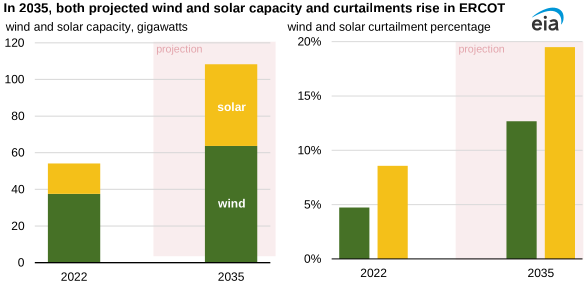
As Texas wind and solar capacity increase, energy curtailments are also likely to rise: EIA

In 2035, both projected wind and solar capacity and curtailments rise in ERCOT

Data source: U.S. Energy Information Administration, UPLAN model simulation of ERCOT power market, and Potomac Economics, State of the Market Report for the ERCOT Electricity Market, May 2023

We project combined wind and solar generating capacity in Texas’s power market will double by 2035, fueling a growing renewable share of total generation. However, without upgrades to the state’s transmission system, wind and solar generation will increasingly be curtailed, according to our recent analysis, A Case Study of Transmission Limits on Renewables Growth in Texas…..
 

Crude oil and natural gas proved reserves held by public companies fell slightly in 2022: EIA

annual proved reserves for 187 exploration and production companies

Data source: Evaluate Energy

International proved crude oil and natural gas reserves held by 187 publicly traded global exploration and production (E&P) companies declined by 5.6 billion barrels of oil equivalent (BOE) in 2022, or 2%, according to data from the companies’ annual financial reports. In 2020, proved reserves held by these public companies had dropped by 9% due primarily to the economic effects of the COVID-19 pandemic, but in 2021, proved reserves increased by 9% from 2020.

Proved reserves are estimated volumes of hydrocarbon resources that an analysis of geologic and engineering data demonstrates with reasonable certainty are recoverable under existing economic and operating conditions. Company assessments of their proved reserves of crude oil and natural gas change from year to year because of revisions to existing reserves resulting from price changes, extensions and discoveries of new resources, purchases and sales of proved reserves, and production.

The decline in these companies’ proved reserves in 2022 was driven primarily by sales of producing properties in response to Russia’s full-scale invasion of Ukraine. In 2022, some large oil companies, including bp and TotalEnergies, divested from Russia. Those divestments, categorized as sales of property in the data, reduced total proved reserves reported by these E&P companies by 12.0 billion BOE in 2022….
 

Texas Creates Task Force to Evaluate Charging Needs for ZEV Trucks: EDF

July 8, 2023 — Texas will create an interagency task force to evaluate infrastructure charging and capacity needs for medium- and heavy-duty vehicles, a tremendous step forward in the state’s ongoing efforts to support the zero-emission vehicle industry.

The taskforce is the result of a rider adopted in the state budget, which was signed into law earlier this month. The rider requires the Texas Department of Transportation to coordinate with the Texas Commission on Environmental Quality, the Public Utility Commission and the Electric Reliability Council of Texas to “evaluate how to deploy zero-emission medium-duty and heavy-duty vehicle charging infrastructure to best support growth in that market” in a way that will “maximize competitiveness, innovation, and efficiency, while also maintaining the integrity and cost-effectiveness of the Texas grid.”


The rider details specific items the taskforce must examine, including:

  • Evaluate national, state and local laws and regulations that impact the manufacturing, operations and public and private investments in the development of MHDV charging infrastructure.
  • Identify opportunities for private fleets to better exchange information with utilities and relative state agencies regarding charging profiles and energy needs for the different classes of zero-emission vehicles in the state.
  • Examine what policies and statewide oversight may be most beneficial to helping expand MHDV charging infrastructure throughout the state.

The newly created task force is the latest example of Texas charting its own, unique path towards the zero-emission transportation future. While states like CaliforniaNew YorkNew Jersey and many other states are pursuing the transition through adoption of Advanced Clean Truck rules, Texas is following its traditional low-regulation, light-touch approach to move into the zero-emission vehicle space at the industry’s pace.

So far, it’s been working. Last summer, the state of Texas awarded $8 million in incentives for the purchase of new electric heavy-duty trucks. That total increased ten-fold this month, with TCEQ announcing $87 million for an all-electric grant program targeted almost entirely at replacing Class 4-8 medium- and heavy-duty trucks and buses. Increased private-sector investments, buoyed by federal grant funding through the IIJA and IRA, are coming together to make the state of Texas one of the top places where fleets are looking to place zero-emission trucks.

With financial assistance for deployment of zero-emission fleets advancing, the task force will take a head-on approach to the other major challenge that comes with zero-emission MHDV adoption: certainty around charging infrastructure.

For fleets and utilities, expanding charging infrastructure can be a chicken-and-egg situation. Fleets want to deploy more ZEV trucks, but only if they know the infrastructure will be there to support them. Utilities in Texas are eager to deliver and provide charging for fleets, but they need to know when and where those deployments will occur.

Rep. Armando Walle, who carried the budget rider and has sat on the powerful budget conference committee the past three legislative sessions, decided to pursue the creation of the task force to break the logjam. The rider brings together the relevant state agencies and instructs them to coordinate directly with fleets, utilities, local governments and community groups. This creates space for all involved parties to determine how to balance regional needs and capacities that allow for flexibility with infrastructure adoption. Additionally, statewide, uniform policies are established to create certainty for fleets that will move vehicles throughout the Lone Star State.

The task force will hold quarterly meetings, beginning in the fall of 2023, and are required to provide a report to the Legislature about their findings by October 1, 2024. EDF will play a close, hands-on role throughout the process, with the goal of advancing a bill or series of bills for the next legislative session, beginning in January 2025 that can further advance the transition to zero-emission vehicles in Texas.